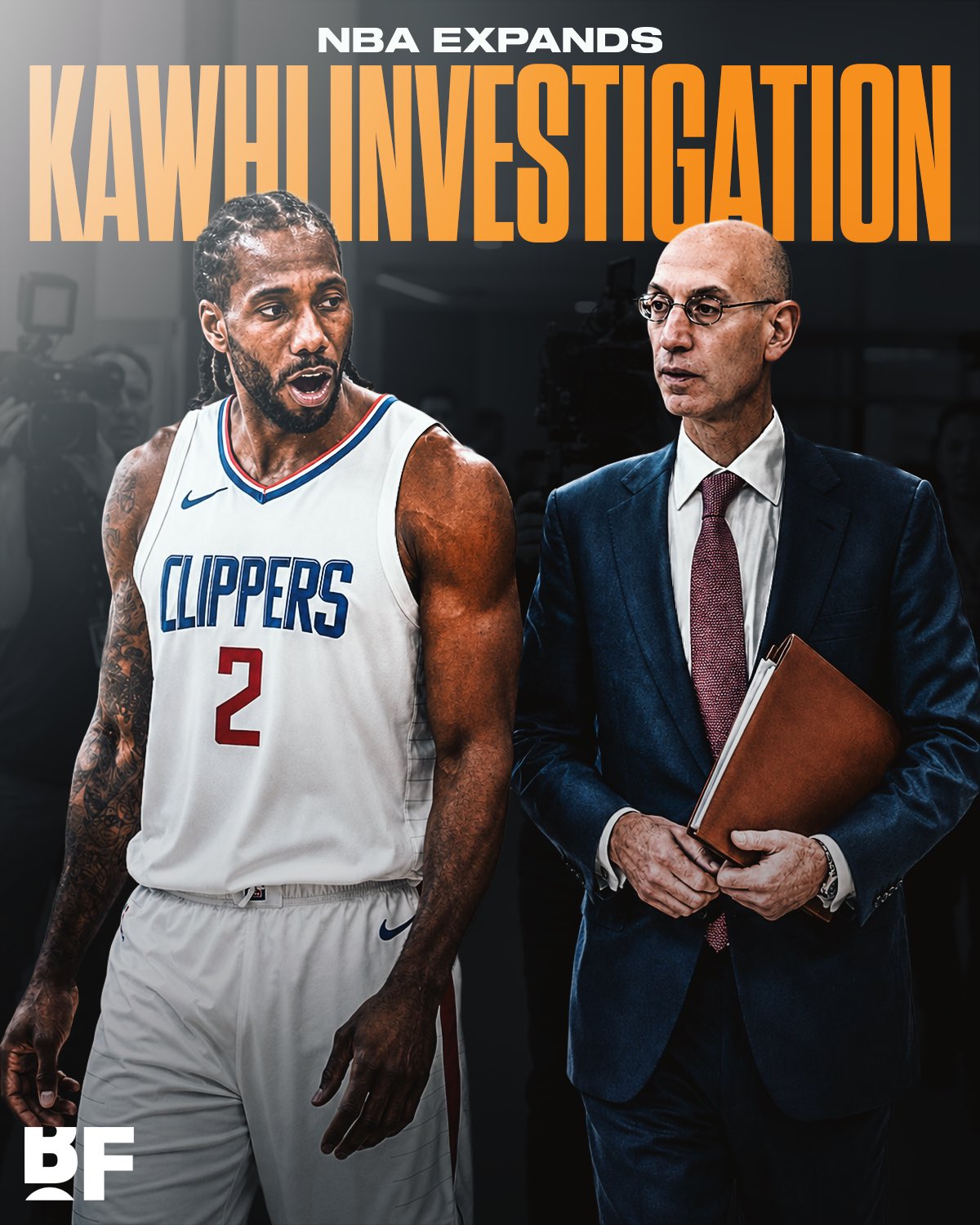
Two weeks ago the Clippers and Raptors agreed on a trade that would send Kawhi Leonard back to the city where he won a championship. The deal is still sitting there, unfinished, because the NBA is not done investigating the Clippers. And the investigation is not narrowing toward a conclusion. It is widening.
League investigators have expanded their probe beyond the $28 million Aspiration endorsement at the center of the case. They have examined whether Leonard had a second, previously unreported endorsement deal with another company, and whether the Clippers improperly covered personal expenses for their star without being reimbursed. What began ten months ago as a question about one suspicious sponsorship has become a broader audit of how money moved around the franchise's best player.
What investigators are now asking
The probe now runs on three tracks. The original one: whether the Clippers used Aspiration to route compensation to Leonard outside the salary cap. The second: whether the team picked up expenses for him that should have counted against it. The third, and newest: the unnamed second company, and what Leonard was paid for. No dollar figure has surfaced, and the company's identity has not been reported.
The question underneath all three is the same. Every dollar a team or its business partners direct to a player is supposed to live inside the cap. An endorsement deal with a team sponsor is legal only if it pays fair market value for real work. Which is exactly where the Aspiration deal keeps failing the smell test.
A campaign that never existed
Former employees of the bankrupt green-banking startup describe a company that spent weeks trying to figure out what it was actually buying for its money. The marketing team brainstormed campaign concepts built around Leonard and went as far as producing mockups that reimagined him as an offshoot of Groot, the Marvel tree character, a tie-in with Aspiration's pledge to plant trees to offset customers' carbon footprints.
Then the work stopped. "Stop thinking about Kawhi," one former employee recalled being told. "This feels like a dead end." No Leonard campaign ever ran. That is the heart of the league's problem with this deal: millions paid to an athlete for marketing work that the people responsible for the marketing say never happened.
Leonard has denied taking part in any scheme, and nothing public ties him to knowledge of Aspiration's finances. But intent matters less than math. If the league concludes the deal was salary in disguise, the cap consequences land on the Clippers either way.
How the Clippers got here
Aspiration was the kind of partner franchises dream about, right up until it wasn't. Steve Ballmer invested $50 million in the company. It signed a 23-year, $300 million sponsorship with the Clippers in 2021, then added the $28 million endorsement deal with Leonard. The startup has since collapsed into bankruptcy, and co-founder Joe Sanberg has agreed to plead guilty to federal charges for defrauding investors.
The league opened its investigation last September and handed the work to Wachtell Lipton, its outside law firm. The Clippers say they have cooperated fully through ten months of interviews and document requests, and their July 9 statement did not hedge: "We did not funnel money to Kawhi Leonard through Aspiration." The team describes itself as a victim of a fraud initiated by Sanberg, one that fooled sophisticated investors and financial institutions alike.
The trade held hostage
On June 30, the Clippers agreed to send Leonard to Toronto for Brandon Ingram, Gradey Dick, unprotected first-round picks in 2031 and 2033, a 2027 pick swap and two second-rounders. It is the reunion Raptors fans have wanted since the summer of 2019, when Leonard delivered a title and left in free agency a month later.
The hang-up is risk. The Clippers have said the deal can only be finalized if Toronto's ownership assumes responsibility for any penalties attached to Leonard's contract. The Raptors have declined, preferring to wait for the league's findings rather than inherit a contract that could theoretically be voided. "The Raptors remain eager to bring Kawhi back to Toronto and look forward to a swift resolution for our players, our organization, and our fans," the team said.
The caution is understandable. Leonard, who turned 35 in June, is entering the final season of the three-year, $152 million extension he signed in January 2024, at a salary of roughly $50 million. Toronto is offering two rotation players and a pile of draft capital for one guaranteed year of a superstar whose paperwork is under a microscope.
What the league can actually do
The collective bargaining agreement gives the commissioner heavy tools for cap circumvention: fines up to $7.5 million, forfeited draft picks, voided contracts and suspensions for team personnel. The only real precedent is ugly. In 2000, the league caught Minnesota promising Joe Smith future money in a secret side agreement. The Timberwolves lost five first-round picks, two of which were later returned, paid a $3.5 million fine and had Smith's contract voided.
The expanded scope is what makes this version dangerous. One suspicious deal can be written off as a rogue sponsor burning investor money. A second undisclosed endorsement, plus covered expenses, starts to describe a pattern, and patterns are what turn investigations into penalty hearings. A resolution is expected after Summer League.
The argument underneath it
Clippers fans have a real case. Ten months of cooperation, no public evidence Leonard did anything but sign a lucrative deal, and a franchise that says it got conned along with everyone else who wired money to Sanberg. The rest of the league sees the sport's wealthiest owner and asks why his star's most generous sponsor happened to be a company he had personally invested $50 million in.
Toronto fans, meanwhile, are stuck refreshing their phones, waiting to learn whether the reunion that would define their offseason survives the findings. A franchise that lost Leonard for nothing once is being asked to bet draft capital that he is clean now.
Adam Silver's office has had ten months to close this case. Its answer so far has been to open new questions. Whatever the investigators keep finding, it is not nothing.