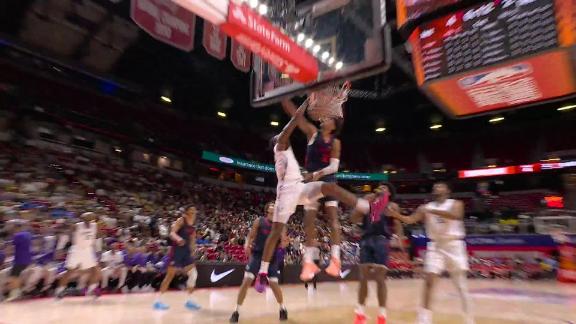
The Utah Jazz closed the offseason with a 15-man roster that blends continuity with modest upgrades. The most notable addition is interior scorer Jordan Hayes, signed after the departure of big man Walker Kessler. Hayes arrived on a one-year contract that includes an out clause after the season and a team option for a second year, giving Utah flexibility while addressing the scoring void left by Kessler’s exit.
Hayes posted a field-goal percentage north of 75 percent during his lone season with the Los Angeles Lakers, a figure that underscores his efficiency around the rim. The contract is structured as a low-risk deal: the out clause lets the Jazz part ways without cap penalty if the fit proves unsatisfactory, while the option year offers a cheap path to retain him should his play translate to Salt Lake City.
Kessler, by contrast, had been a defensive anchor, averaging close to two blocks per game and providing a rim-protecting presence the Jazz now lack. His departure creates a noticeable gap in interior defense and rebounding, a hole that Hayes does not fully fill. Hayes is primarily an interior scorer rather than a rim protector, meaning the Jazz must rely on perimeter defenders and collective rebounding to compensate for the loss of Kessler’s shot-blocking.
From a scheme perspective, Hayes offers a high-percent scorer who can finish pick-and-roll actions and generate second-chance opportunities. Coach Will Hardy’s system emphasizes spacing and ball movement, so Hayes’ ability to convert at the rim without demanding many touches aligns with the Jazz’s offensive philosophy. However, the lack of a true shot-blocker may force the team to employ more zone concepts or double-team opposing post players to mask the deficiency.
Utah’s front office has a history of extracting value from low-cost contracts, and the Hayes signing continues that trend. While the move does not fully replace Kessler’s rim-protection, it preserves financial flexibility and signals a willingness to address front-court depth without overcommitting. The decision reflects an organizational belief that the core roster can remain competitive while the team evaluates the impact of the new addition.
The next few weeks will determine whether Hayes cements his role or is released at the season’s end. Training camp will reveal how his efficiency translates against the Jazz’s defensive schemes, and the team will assess the option year before the trade deadline. If Hayes proves a reliable finisher, the Jazz could retain him for a modest second year; if not, the out clause provides a clean exit, allowing Utah to explore alternative front-court options in free agency or via trade.