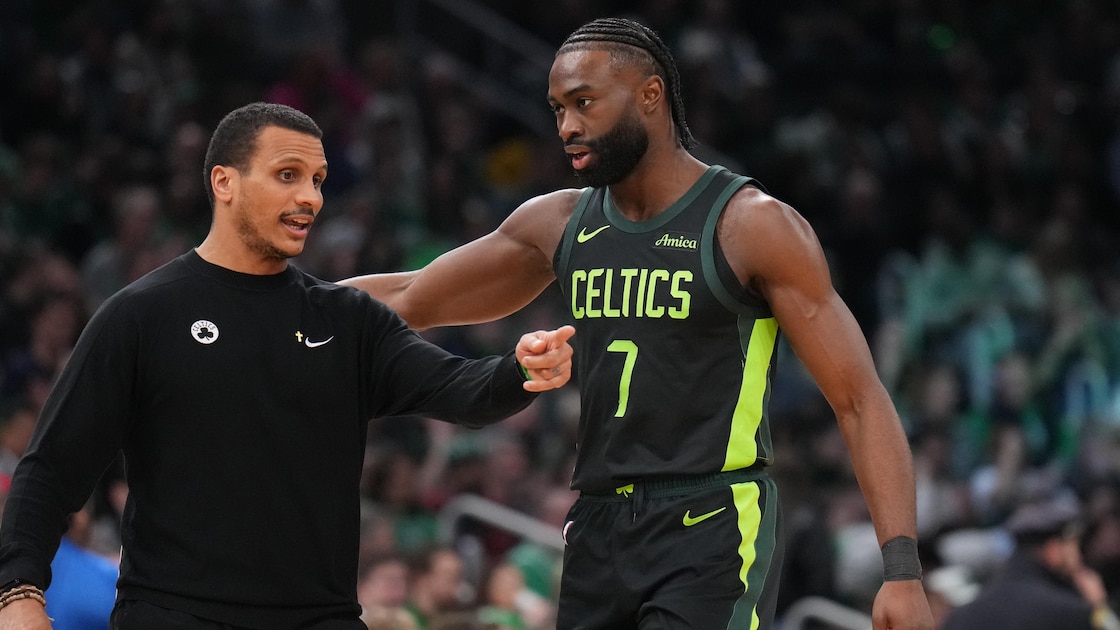
The Boston Celtics announced a blockbuster trade on July 6 that sends former forward Jaylen Brown to the Philadelphia 76ers in exchange for nine-time NBA All-Star Paul George and a package of future draft picks. The move marks a dramatic shift for a franchise that has already won 18 championships, as it replaces a recent Finals MVP with a player whose value has been questioned after two under-performing seasons in Philadelphia.
George arrives in Boston still under the four-year, $212 million contract he signed with the 76ers in 2024. With two years remaining on the deal, the Celtics inherit a sizable salary commitment that many analysts have labeled overpaid relative to his recent production. During his two-year stint with Philadelphia, George averaged 16.7 points per game, grabbed 5.3 rebounds, and dished out 4.0 assists while shooting 43.4 % from the field and 37.5 % from three-point range in 78 contests. Those numbers represent a noticeable dip from the more than 20 points per game he posted in each of his nine seasons before joining the Sixers.

The draft component of the trade is complex. Boston receives a 2028 first-round pick that originally belongs to the Los Angeles Clippers. If that pick falls in the top 16, Boston gains the right to swap its own 2028 first-rounder, currently the worse of its own and San Antonio’s picks, with the better of the Clippers’ pick or, if Philadelphia’s 2028 pick lands in the top eight, Philadelphia’s 2028 first-rounder. In addition, the Celtics acquire Philadelphia’s unprotected 2031 first-round pick, the most favorable 2028 second-round pick among Golden State, Milwaukee, or Oklahoma City, and the most favorable 2030 second-round pick among Phoenix, Portland, or Washington.
From a strategic standpoint, the Celtics are trading a young, ascending star in Brown for a veteran who has struggled with injuries and a decline in offensive output. The exchange gives Boston immediate veteran depth at the wing, but it also adds cap flexibility in the form of draft assets that could be used to replenish the roster or package in future deals. The risk is that George’s health and performance may not align with the expectations of a team that has recently contended for a title.
Looking ahead, Boston’s front office appears to be balancing short-term competitiveness with long-term roster construction. The draft picks provide a hedge against the uncertainty surrounding George’s remaining contract years, while the loss of Brown removes a key scoring option and a recent Finals MVP from the lineup. How the Celtics integrate George, manage his contract, and leverage the acquired picks will shape the franchise’s trajectory over the next several seasons.