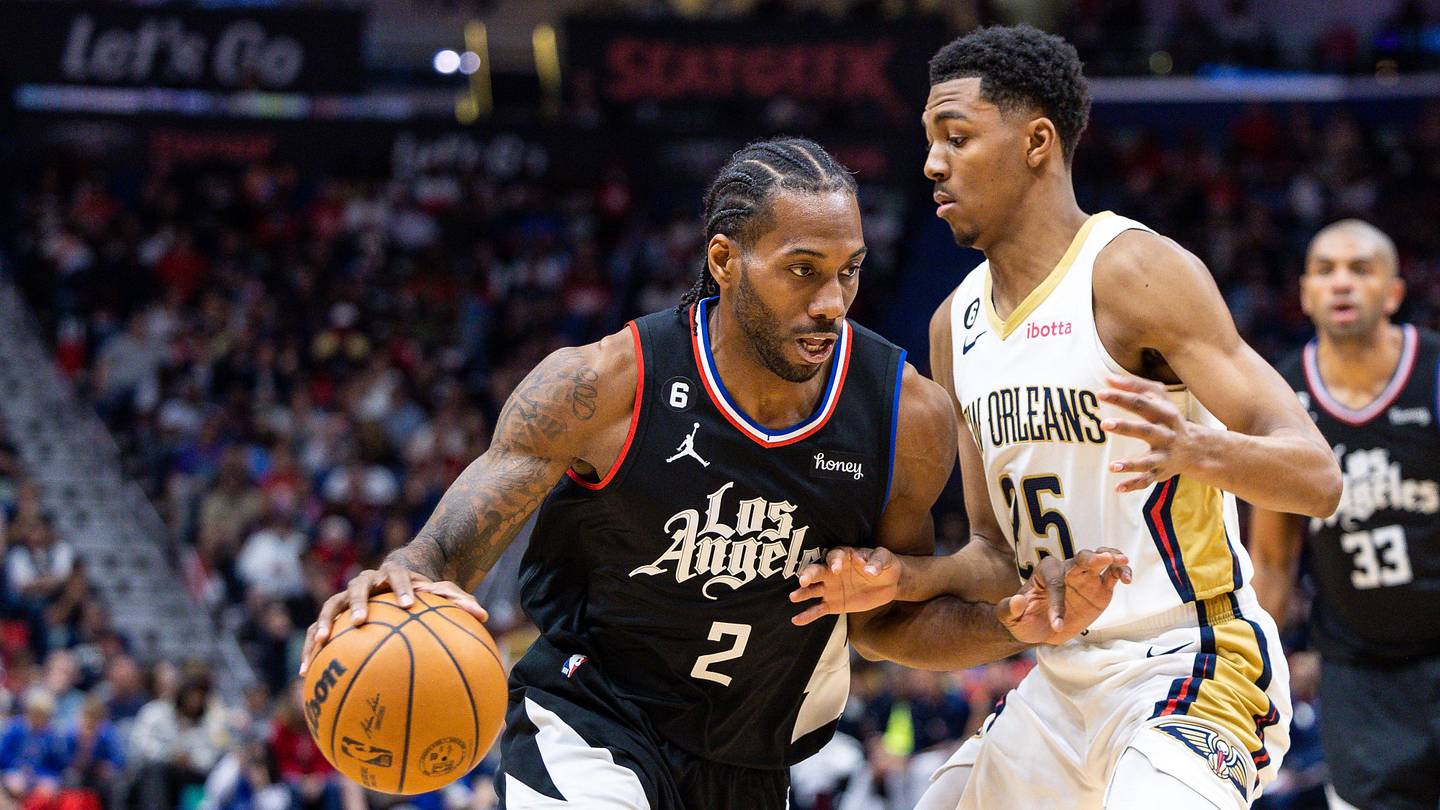
The Golden State Warriors are approaching a crossroads that could define the final act of their current competitive cycle. As the front office looks to maximize the remaining years of their established core, two distinct paths have emerged through the trade market. The choice sits between the established brilliance of Kawhi Leonard and the rising versatility of Trey Murphy III.
Each player represents a different philosophy regarding roster construction and risk management. Leonard is a proven champion whose ceiling remains as high as any player in the league when his body allows him to compete. Murphy is a younger talent who provides the length and perimeter shooting that the modern game demands with a much lower degree of medical uncertainty.
Reporting from Anthony Slater of ESPN indicates that Murphy is currently more obtainable than he was during the previous trade deadline. At that time, the New Orleans Pelicans rebuffed the Warriors' inquiries, keeping their young forward as a vital part of their rotation. The shift in availability suggests a change in leverage or perhaps a shift in the Pelicans' long-term financial planning.
Simultaneously, Kevin O'Connor of Yahoo Sports reports that the Warriors maintain a strong interest in Leonard. This interest is not a new development, as the team reportedly made a push for the Clippers forward at the trade deadline. The persistence of this interest highlights Golden State's desire for a secondary creator who can alleviate the offensive burden on the perimeter.
While the specific draft capital required for either player remains a matter of negotiation, the decision involves more than just a tally of first-round picks. The Warriors must weigh the immediate impact of a superstar against the long-term reliability of an emerging wing. If the cost in assets is comparable, the logic of the move shifts toward the player who can stay on the floor.
Kawhi Leonard's medical history is the primary factor in any trade discussion involving the Clippers star. His career has been defined by incredible peaks interrupted by significant absences. These gaps in availability have often occurred at the most critical moments of the season, leaving his teams short-handed when the stakes are highest.
Leonard failed to finish the 2021, 2023, and 2024 playoffs due to injuries that proved too severe to play through. He missed the entirety of the 2021-22 season while recovering from a torn ACL. His history of lower-body issues dates back further, including a quad injury that sidelined him for almost all of the 2017-18 season.
Even his earlier post-season runs were marred by physical setbacks. In the 2017 Western Conference Finals, Leonard missed the final three games after an ankle injury resulting from a closeout by Zaza Pachulia. This pattern of missed time has become a central part of his professional profile, creating a difficult calculation for any team looking to acquire him.
Recent data points do not offer much reassurance regarding Leonard's durability. He missed 45 games during the 2024-25 season, representing a significant portion of the schedule. While he enjoyed a relatively healthy 2025-26 campaign, missing only 17 regular-season games, that season ended abruptly with a loss in the play-in tournament.
Trey Murphy III presents a different set of considerations for the Warriors' front office. At 26 years old, he fits a timeline that extends beyond the immediate championship window. While he does not have a perfectly clean bill of health, his issues have been far less systemic than those facing Leonard.
Murphy has missed 93 games over the course of his five-year career. This total indicates that he is not immune to the physical toll of an NBA season. However, the nature of his absences allows for a more reasonable expectation that he will be available for a deep playoff run. He does not carry the same history of chronic knee or quad issues that have plagued Leonard.
In terms of lineup fit, Murphy offers a blend of size and shooting that would integrate seamlessly into the Warriors' offensive system. His ability to provide spacing allows more room for rim pressure from other positions. He can occupy a role that demands high-level defensive activity without the need for constant offensive touches.
Leonard, by contrast, is a high-usage player who changes the gravity of the floor. His presence would provide the Warriors with a legitimate second option who can create his own shot in isolation. This skill is often the difference between a second-round exit and a championship, provided the player is healthy enough to utilize it.
The trade value of both players is tied to their respective roles and future potential. Murphy's age and contract status make him a valuable asset who could serve as a bridge to the next era of Golden State basketball. Leonard's value is tied to his production, but his salary slot and age make him a more volatile investment.
For the Warriors, the decision comes down to the reliability of their secondary star. The front office must decide if they can afford another season where their playoff hopes hinge on a player with a history of post-season injuries. The team has already seen how quickly a season can derail when key contributors are unavailable.
If the Warriors target Murphy, they are betting on a player who can grow within their system and provide consistent minutes. He offers a level of stability that is hard to find in a trade market often dominated by aging stars. His presence would allow the coaching staff to build a rotation with more certainty.
If they choose Leonard, they are embracing a high-variance strategy. The potential reward is a return to the top of the league, but the risk of a total loss is significant. The history of Leonard's recent playoff exits suggests that the Warriors would be gambling on a trend they have no power to change.
Draft capital remains the great equalizer in these negotiations. If the Pelicans demand an excessive number of picks for Murphy, the Warriors might find the Leonard path more palatable despite the risks. However, if the price for both is similar, the younger and more durable option becomes the clear choice for a team trying to avoid a slow decline.
The Warriors' interest in both players shows they are aware of the need for a dynamic wing defender who can shoot. The modern NBA requires multiple players who can switch across positions and threaten from the perimeter. Both Leonard and Murphy meet these criteria, but they do so with very different levels of physical reliability.
Choosing Murphy would be an acknowledgment that availability is a skill in itself. For a team that has already navigated the complexities of aging superstars, adding a 26-year-old with a manageable injury history provides a necessary hedge. It secures the present without completely mortgaging the future.
The Pelicans' willingness to engage in talks gives the Warriors a chance to secure a player who was previously off-limits. This opening is a rare opportunity to acquire a young wing with a proven track record of efficient play. The Warriors' front office will have to move quickly if they want to capitalize on this shift in the market.
Ultimately, the goal is to provide Stephen Curry with a supporting cast that can withstand the rigors of a two-month playoff grind. Leonard has struggled to meet that requirement for several years, regardless of his regular-season performance. Murphy's history suggests a much higher probability of being active when the first round begins.
While the allure of Leonard's peak performance is tempting, the Warriors cannot afford to spend their remaining assets on a player who might be a spectator by May. The safer and more logical move is to prioritize the player who has a higher likelihood of finishing the season on the court.

 Golden State Warriors